A baby sound machine can work wonders for newborn sleep. But only if you use it correctly.
Poor placement or too much volume can reduce how well it works. Worse, it can pose risks you didn't expect.
This guide shows you exactly how to use a sound machine safely. You'll learn the right distance, proper volume, and when to turn it on.
Quick Answer: How Do You Use a Baby Sound Machine Safely?
- Volume: Below 50 dB at crib level (use a free decibel app to check)
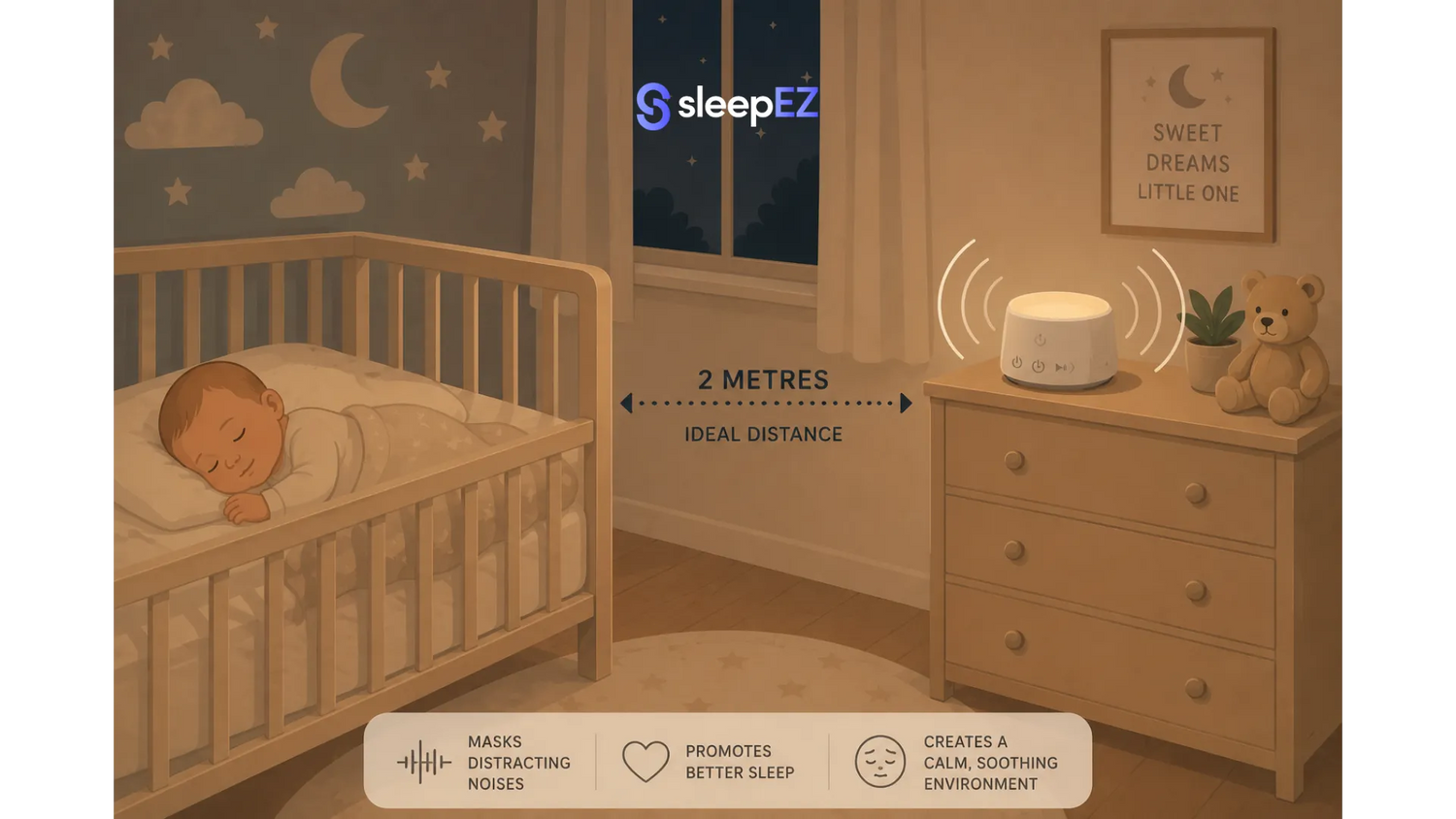
- Distance: At least 2 metres (6–7 feet) from the crib
- Placement: On a stable surface, pointed toward the centre of the room, not directly at the baby
- Sound type: White noise, pink noise, or brown noise, avoid music with variable volume
- Duration: Safe for continuous overnight use at appropriate volume and distance
Where Should You Place a White Noise Machine for a Baby?
The recommended placement:
- On a dresser, shelf, or nightstand at least 2 metres (6–7 feet) from the crib
- Pointed toward the centre of the room, not directly at the baby's head
- On a stable surface where it cannot be knocked over
- Away from the crib, never inside it or attached to the crib rails
What to avoid:
- Inside the crib or attached to the crib rails
- On the floor directly beside the crib
- Pointed directly at the baby's ears
- On an unstable surface
How Far Should a White Noise Machine Be From a Baby?
At least 2 metres (6–7 feet) away from the crib.
This is the most commonly cited safe distance from paediatric sleep experts. At this distance, a machine set to a safe volume (below 50 dB at the source) will measure approximately 45–50 dB at the crib, within the recommended safe range.
Why distance matters: Sound volume decreases with distance. A machine that measures 65 dB at 30cm will measure approximately 50 dB at 2 metres.
Getting the distance right is as important as setting the volume correctly.
How to check: Use a free decibel meter app. Place your phone at crib mattress level, not next to the machine, and check the reading. Aim for 45–50 dB.
Baby Sound Machine Safety Tips
- ☐ Keep volume below 50 dB at crib level (check with a decibel app)
- ☐ Place the machine at least 2 metres from the crib
- ☐ Never place the machine inside the crib or attached to the crib rails
- ☐ Keep cords out of reach, use a cordless or battery-operated machine if possible
- ☐ Use continuous sounds (white, pink, or brown noise), avoid music with variable volume
- ☐ Check the volume regularly as your baby grows
- ☐ Use a stable surface where the machine cannot be knocked over
- ☐ Don't use Bluetooth speakers placed close to the baby's head
How Long Should You Use a Sound Machine for Your Baby's Sleep?
This is one of the most common questions parents have, and the answer is reassuring.
There is no set time limit. White noise is safe for continuous overnight use at appropriate volumes. Many families use it for every sleep from newborn through toddlerhood.
Age guidelines:
| Age | Typical Usage |
|---|---|
| 0–6 months | Every sleep, highly beneficial |
| 6–12 months | Every sleep, still very helpful |
| 1–2 years | Most families continue without issues |
| 2–3 years | Some families begin weaning if desired |
| 3+ years | Still safe if helpful, personal preference |
When to consider stopping: Only when your family wants to.
There's no developmental reason to stop white noise at a specific age. See our full guide: When Should You Stop Using White Noise for Your Baby?
Quick Setup Checklist (TL;DR)
Setting up right now? Here's what matters most:
Sound Type: Continuous white noise or gentle whooshing
Volume: Under 50 dB (quiet conversation level)
Distance: At least 2 meters (6-7 feet) from the crib
Duration: Naps and nighttime only, not all day
Routine: Turn on before sleep, keep it the same each night
Keep reading for detailed steps.
Does My Baby Actually Need a Sound Machine?
Use a sound machine if:
- Your baby startles easily during sleep
- You live in a noisy place (traffic, thin walls, siblings)
- Your baby struggles with sleep changes or wakes often at night
- You want to create a steady sleep cue
- Your baby sleeps better in the car or with background noise
You can skip it if:
- Your baby already sleeps well in a quiet room
- You live somewhere naturally quiet
- Your baby doesn't startle from household sounds
- You prefer complete silence for sleep
The bottom line: A sound machine isn't required. It's just a tool. If your baby sleeps soundly without one, don't add it. But if you're dealing with night wakings, outside noise, or frequent startles, it can help a lot.
Choosing a Baby Sound Machine With Safe Volume Control
When choosing a sound machine for your baby, prioritise:
- Adjustable volume with clear increments, so you can set it precisely and reduce gradually when weaning
- Continuous play mode, loops without stopping or changing volume overnight
- Multiple sound options, white noise, pink noise, and brown noise at minimum
- Timer function, useful for naps
- Compact, stable design, easy to position at the recommended distance
The Hush Sound Machine offers all of these features in a compact design suitable for nurseries. Its adjustable volume makes it easy to maintain safe levels and reduce gradually if you decide to wean.
5 Step Guide to Using a Baby Sound Machine
Step 1: Choose the Right Sound (Simple & Consistent)
What to choose:
- Continuous white noise
- Gentle pink noise
- Soft whooshing or fan-like sounds
What to avoid:
- Sudden peaks or volume changes
- Rainstorms with thunder
- Melodies that wake up the brain instead of calming it
Babies sleep best with smooth, womb-like noise. Not patterns, not melodies, not start-stop tracks.
The sound should fade into the background. Your baby shouldn't be listening to it. They should be sleeping through it.
Step 2: Set the Safe Volume (Below 50 dB)
Parents always worry about this. Here's the clear answer.
Key rules:
- Keep volume under 50 decibels
- That's about as loud as a quiet conversation
- If you can't measure it, use the arm's-length rule
The arm's-length rule: Stand an arm's length from the machine. If the sound feels loud to you, it's too loud for your baby.
Never max out the volume settings. Check the level during both naps and nighttime. Sound can feel different at 2 a.m. than it does at 2 p.m.
Safe volume ensures white noise helps your baby sleep. Not harm their developing hearing.
Step 3: Place the Machine 2+ Meters Away from the Crib
Distance matters more than most parents think.
Exact placement rules:
- Minimum distance: 2 meters (about 6 to 7 feet)
- Never put it inside the crib
- Don't place it behind curtains or pillows (fire risk from overheating)
- Angle the sound toward the center of the room
Point it away from your baby's head. The goal is to fill the room with gentle noise. Not blast sound at their ears.
If your nursery is small, put the machine as far as possible from the crib. Even 1.5 meters is better than right next to their head.
Step 4: Use It for Sleep Only (Not All Day)
Proper timing:
- Safe for naps and nighttime
- Don't use during wake windows
- Helps baby tell day from night
- Reduces overdependence on constant sound
White noise should be a sleep signal. Not a constant background hum.
When your baby wakes up, turn it off. Let them hear normal household sounds during play time. This helps them learn that white noise means rest.
Some parents worry about creating a dependency. The truth is that most babies naturally outgrow the need for sound machines. But running it 24/7 can make weaning harder later.
Step 5: Make White Noise Part of a Bedtime Routine
How to build it in:
- Turn it on before feeding or swaddling
- Pair with dim lights and gentle motions
- Keep the same sound every night
- Use it to mask sibling noise, street sounds, or pets
The sound machine should signal calm and safety. Just like a bedtime lullaby.
Babies love predictable patterns. When they hear that familiar sound, their brain knows what comes next: sleep.
Start your routine the same way each night. Dim the lights, turn on the sound machine, then move into feeding or rocking. Keep the order consistent.
Read: White Noise Machine for Baby
How Sound Machine Use Changes as Your Baby Grows
The basic safety rules stay the same at every age. But white noise helps in different ways as babies develop.
0-3 Months (Newborn Stage)
White noise mimics the womb. It's especially helpful during the "fourth trimester."
It can reduce startle reflex disruptions (the Moro reflex). Safe to use for all naps and nighttime sleep.
Volume can be slightly higher at this stage, but still under 50 dB. Newborns are used to constant sound from inside the womb.
3-6 Months
Keep using it as sleep habits form. This is when the 4-month sleep regression often hits.
Your baby is now more aware of sounds around them. White noise masks doorbells, barking dogs, and other disruptions.
6-12 Months
White noise helps with separation anxiety and sleep transitions. Useful during teething when nights get rough.
You can start pairing it with other sleep cues now. A lovey or a specific pre-bed routine works well together.
12+ Months (Toddler Stage)
Continue if your child is used to it. Sudden removal can disrupt sleep you've worked hard to build.
It helps mask household noise in the morning. Especially helpful when siblings wake up first.
You can gradually wean after age 2 or 3 if you want. But there's no rush. Many families use white noise for years.
Key takeaway: White noise is especially helpful during sleep regressions, growth spurts, and big changes like moving to a new room.
Bonus Tips for Maximum Safety & Effectiveness
Quick reminders:
- Check your device often for heat buildup
- Avoid portable Bluetooth speakers not made for continuous use
- When choosing sleep products for any age, look for volume control and safety features. Just like adult sleep tools need hearing protection, baby sound machines should offer precise volume settings and timer functions
- Make sure the machine is stable and out of reach
- Test the sound from baby's ear height, not from where you're standing
- Avoid phone apps that might spike in volume from notifications
Common Mistakes Parents Should Avoid
Placing the device too close. Even 1 meter away is too near. Aim for 2 meters minimum.
Using loud, high-pitched sounds. White noise should be low and steady. Not sharp or piercing.
Changing sound settings frequently. Pick one sound and stick with it. Babies need consistency.
Running white noise 24/7. Use it for sleep only. Turn it off during wake windows.
Using untested DIY white noise sources. Hair dryers and vacuum recordings can vary wildly in volume. Stick with devices made for baby sleep.
Final Thoughts
When used safely, a baby sound machine is a gentle tool. It helps babies fall asleep faster and stay asleep longer.
Follow these five steps:
- The right sound (continuous, womb-like)
- Safe volume (under 50 dB)
- Proper distance (2+ meters away)
- Sleep-only use (not all day)
- Consistent routine (same sound, same time)
You'll create a calming, safe space your baby can rest in comfortably.
You're doing great. Now you know how to do it safely and with confidence.
Frequently Asked Questions
Is it safe to leave a sound machine on all night?
Yes, at safe volumes (below 50 dB at crib level) and proper distance (2+ metres). Continuous overnight use is considered safe by most paediatric sleep experts and can actually help babies link sleep cycles without waking.
Can a sound machine damage a baby's hearing?
Only if used at excessive volumes (70+ dB) or placed too close to the baby. At the recommended 50 dB or below, at the recommended 2-metre distance, white noise does not damage hearing.
Can babies become dependent on white noise?
All babies develop sleep associations, white noise is simply one of them. It's not inherently more problematic than other associations, and it has the advantage of being consistent and controllable.
Should I use white noise during naps?
Yes, using the same sleep environment for naps and nighttime sleep helps reinforce sleep associations and makes the transition between sleep cycles easier.
What is the safest white noise setting for babies?
Below 50 dB at crib level, placed at least 2 metres away. Use a free decibel meter app to check your specific setup.
How do I know if the sound machine is too loud?
If you can hear it clearly from the hallway with the door closed, or if you need to raise your voice to speak normally in the room, it's likely too loud. Use a decibel app to check.
What sounds are best for newborns?
White noise and pink noise are both suitable for newborns. Pink noise (which sounds like rain or wind) is often preferred because its softer, lower-frequency profile is gentler on developing hearing.
What volume should white noise be for babies?
Keep it under 50 decibels. About as loud as a quiet conversation or a refrigerator hum. If it feels loud to you from arm's length, it's too loud for your baby.
How far should a sound machine be from a crib?
At least 2 meters (6 to 7 feet) away. Never place it inside the crib or right next to your baby's head.
Can I use white noise all night for my baby?
Yes. White noise is safe to use throughout naps and nighttime sleep. Just avoid running it during wake windows so your baby learns to tell day from night.
When should I stop using a sound machine?
There's no set age to stop. Many families keep using white noise through toddlerhood and beyond. If your child sleeps well with it, you can continue as long as it helps.

Leave a comment
This site is protected by hCaptcha and the hCaptcha Privacy Policy and Terms of Service apply.