
Quick Answer: Does Circadian Rhythm Change With Age?
Yes, your circadian rhythm changes significantly throughout life.
- Babies have an immature circadian system and sleep in short, frequent bursts
- Children gradually develop earlier, more stable sleep patterns
- Teenagers experience a biological shift toward later sleep and wake times
- Adults have the most stable circadian rhythms, typically aligned with conventional schedules
- Older adults often shift toward earlier sleep and wake times, and experience lighter, more fragmented sleep
These changes are driven by shifts in melatonin timing, changes in the suprachiasmatic nucleus (your brain's master clock), and hormonal changes throughout life.
Circadian Rhythm by Age: A Timeline
| Age Group | Typical Sleep Pattern | Key Characteristic |
|---|---|---|
| Newborn (0–3 months) | 14–17 hours, fragmented | No established circadian rhythm |
| Infant (4–12 months) | 12–15 hours, consolidating | Rhythm begins to develop |
| Toddler (1–3 years) | 11–14 hours | Strong early sleep preference |
| Child (4–12 years) | 9–11 hours | Stable, early sleep pattern |
| Teenager (13–17 years) | 8–10 hours | Delayed phase, later sleep and wake |
| Young Adult (18–25 years) | 7–9 hours | Gradual return toward earlier timing |
| Adult (26–64 years) | 7–9 hours | Most stable circadian rhythm |
| Older Adult (65+) | 7–8 hours | Advanced phase, earlier sleep and wake, lighter sleep |
Why Teenagers Stay Up Late
Teenagers aren't just staying up late by choice, there's a genuine biological reason.
Delayed melatonin release.
During puberty, the timing of melatonin secretion shifts later by 1–3 hours. This means a teenager's body doesn't signal "time to sleep" until significantly later than a child or adult.
Later circadian phase.
The entire circadian rhythm shifts later during adolescence, not just sleep timing, but peak alertness, body temperature, and cortisol release.
Social jet lag.
When school start times don't align with teenagers' biological sleep timing, they accumulate significant sleep debt during the week and attempt to recover on weekends, further disrupting their rhythm.
This is biology, not laziness.
Research consistently shows that early school start times conflict with adolescent circadian biology. Many health organisations now recommend later school start times for secondary students.
What Changes Happen to Your Circadian Rhythm as You Age?
Your body's internal clock doesn't work the same way at 65 as it did at 25. Two major changes happen as you get older, and both affect how and when you sleep.
The Main Change: An "Advanced" Sleep Phase (ASPS)
Advanced Sleep Phase Syndrome is the medical term for becoming an extreme early bird. If you find yourself yawning at 7 PM and wide awake at 4 AM, this is likely what's happening.
Your entire sleep-wake cycle shifts earlier by 2-3 hours. The problem isn't that you can't sleep. It's that your body wants to sleep and wake on a schedule that doesn't match normal life.
This explains why your 70-year-old neighbor is mowing the lawn at dawn. Their body genuinely thinks it's time to start the day.
A Weaker or More "Fragmented" Rhythm
The second change is less obvious but equally frustrating. Your circadian rhythm loses strength.
Think of it like a radio signal. When you're young, the signal is strong and clear. As you age, it gets weaker and harder to pick up. This means:
- You wake up multiple times during the night
- Small noises or temperature changes disturb your sleep more easily
- You feel the urge to nap during the day
- Your sleep feels lighter and less restorative
It's not just about timing anymore. The quality and consistency of your sleep pattern decline.
Why Older Adults Wake Up Earlier
The shift toward earlier sleep and wake times in older adults is called Advanced Sleep Phase Syndrome (ASPS) when extreme, but a milder version is a normal part of ageing.
Why it happens:
Weakened suprachiasmatic nucleus.
The brain's master clock (SCN) becomes less robust with age, producing weaker circadian signals.
Earlier melatonin timing.
Melatonin is released earlier in the evening for older adults, making them sleepy earlier and causing earlier morning waking.
Reduced light sensitivity.
Older eyes transmit less light to the retina, weakening the light-based signals that set the circadian clock. Less daytime light exposure means a weaker, earlier-running clock.
Less deep sleep.
Older adults spend less time in Stage 3 deep sleep, making sleep lighter and more easily disrupted by internal or external signals.
Why Do Older People Wake Up at 4 or 5 AM?
Early morning waking in older adults is extremely common and is usually a combination of:
- Advanced circadian phase, the body clock has shifted earlier, so "morning" arrives sooner
- Reduced sleep pressure, older adults accumulate less adenosine (sleep pressure chemical) during the day, making it harder to stay asleep
- Lighter sleep, less deep sleep means more vulnerability to waking from internal signals (body temperature changes, bladder pressure) or external sounds
- Reduced melatonin, melatonin production declines with age, weakening the signal that maintains sleep
What can help:
- Bright light exposure in the morning to anchor the circadian rhythm
- Avoiding bright light in the early evening
- Regular physical activity
- A consistent sleep schedule
- A dark, quiet sleep environment, a sleep mask and white noise machine can help
Why Does Your Internal Clock Change With Age?
Three main factors drive these changes. Some are biological and unavoidable. Others you can influence.
Changes in Your "Master Clock" (SCN)
The suprachiasmatic nucleus (SCN) is a tiny region in your brain that controls your circadian rhythm. As you age, the SCN loses cells and becomes less sensitive to light signals from your eyes.
This weakens its ability to keep a strong, consistent rhythm. The result is a clock that runs earlier and sends weaker signals throughout the day.
Melatonin Production Shifts
Your body produces melatonin, the hormone that makes you feel sleepy. In older adults, melatonin release often starts earlier in the evening.
If melatonin begins flooding your system at 6 PM instead of 9 PM, you'll naturally feel tired earlier. This reinforces the advanced sleep schedule.
Less Light Exposure
This is the factor you can control most. Older adults typically spend more time indoors. They get less bright morning light, which helps set the clock to a later schedule.
At the same time, many older adults are exposed to bright lights at night from TV screens or bathroom trips. This confuses the already-weakened clock, making it harder to maintain any consistent rhythm.
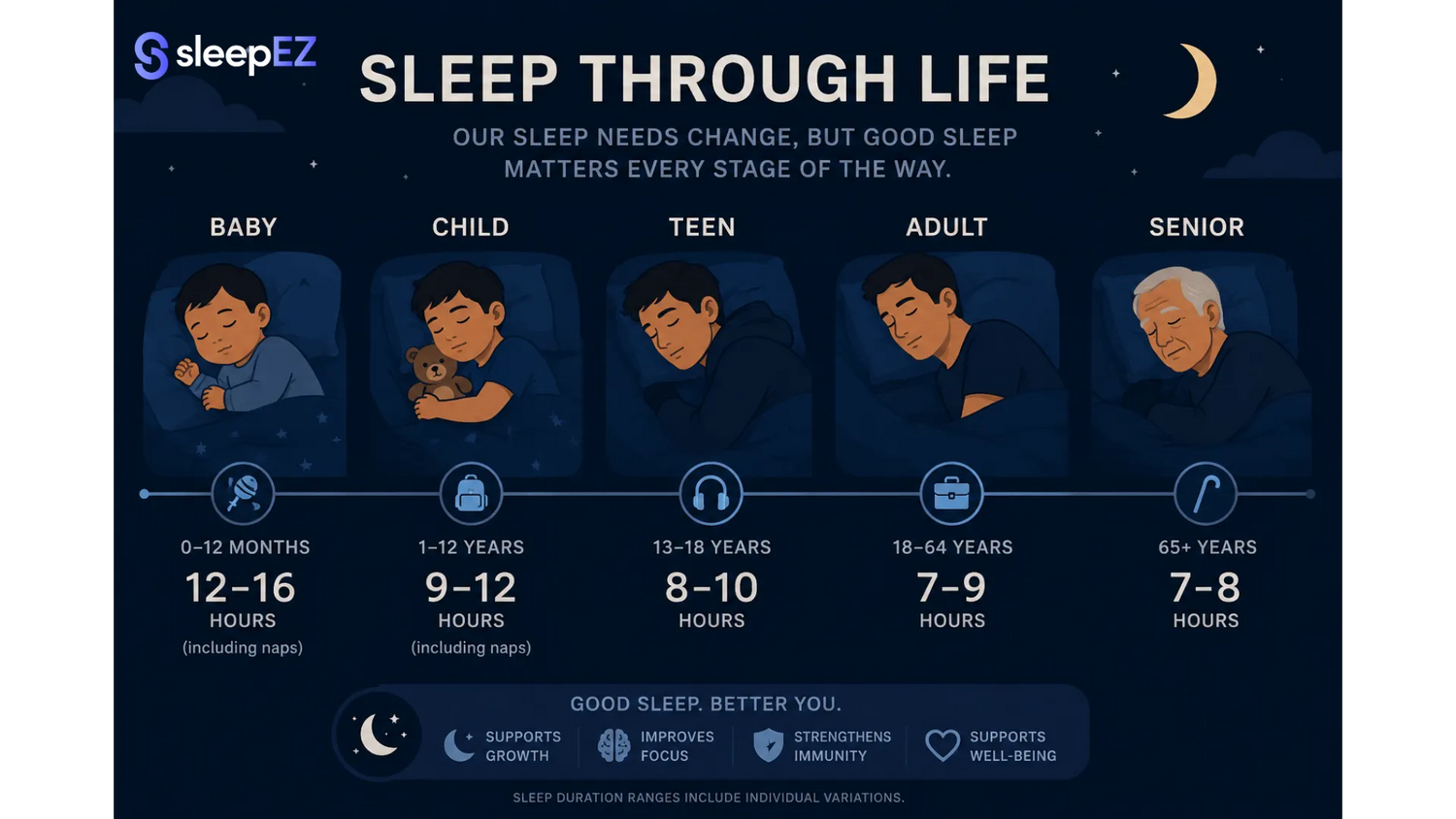
How Much Sleep You Need at Every Age
| Age Group | Recommended Sleep |
|---|---|
| Newborns (0–3 months) | 14–17 hours |
| Infants (4–11 months) | 12–15 hours |
| Toddlers (1–2 years) | 11–14 hours |
| Preschoolers (3–5 years) | 10–13 hours |
| School-age (6–13 years) | 9–11 hours |
| Teenagers (14–17 years) | 8–10 hours |
| Adults (18–64 years) | 7–9 hours |
| Older Adults (65+) | 7–8 hours |
Sleep needs are highest in infancy and childhood, when the brain and body are developing most rapidly. They stabilise in adulthood and decline only slightly in older age, though sleep quality often changes more than quantity.
Can You Reset an Ageing Circadian Rhythm?
You can't reverse age-related circadian changes, but you can significantly support your body clock at any age.
Effective strategies:
Morning bright light.
Exposure to bright light within an hour of waking is the most powerful circadian signal. For older adults, even 20–30 minutes of outdoor light or a light therapy lamp can help anchor the rhythm.
Consistent sleep schedule.
Going to bed and waking at the same time every day, including weekends, strengthens circadian signals regardless of age.
Evening light reduction.
Reducing bright and blue light in the 2 hours before bed helps preserve melatonin timing.
Regular physical activity.
Exercise is a powerful circadian synchroniser. Even moderate daily activity improves sleep quality in older adults.
Sleep environment optimisation.
A dark, quiet, cool bedroom supports sleep quality at every age. A sleep mask blocks early morning light that can trigger premature waking.
A sound machine masks household sounds that lighter sleepers are more vulnerable to.
When Are Sleep Changes a Medical Concern?
Most age-related sleep changes are normal. However, speak with your doctor if you experience:
- Excessive daytime sleepiness, falling asleep during activities, not just feeling tired
- Persistent insomnia, difficulty sleeping 3+ nights per week for 3+ months
- Loud snoring with gasping or choking, may indicate sleep apnea
- Sudden, dramatic changes in sleep timing, particularly in older adults
- Restless legs or periodic limb movements, uncomfortable sensations that disrupt sleep
- Significant daytime impairment, memory, concentration, or mood problems related to poor sleep
These symptoms may indicate treatable conditions rather than normal ageing.
How to Manage Age-Related Sleep Changes
You can't stop your circadian rhythm from changing, but you can work with it instead of against it.
1. Use Light Therapy Strategically
Light is the most powerful tool for adjusting your internal clock.
Get bright light in the afternoon and early evening.
This pushes your clock later, helping you stay awake longer and wake up later. Spend 30-60 minutes outside between 4-7 PM, or use a light therapy box.
Avoid bright light in the early morning.
If you wake up at 4 AM, don't turn on all the lights. Keep them dim until your desired wake-up time. This prevents reinforcing the early schedule.
2. Maintain a Strict Schedule
Consistency strengthens a weak rhythm. Go to bed and wake up at the same time every day, even on weekends.
Pick times that work with your natural tendency. If your body wants to sleep at 8 PM, fighting it until midnight will backfire.
Instead, aim for 9 PM and work with light exposure to gradually shift it later if needed.
3. Practice Excellent Sleep Hygiene
A weaker rhythm means your sleep is lighter and more easily disturbed. You need to control your environment more carefully than you did when you were younger.
Keep your bedroom cool, dark, and quiet. Even small amounts of light or noise can wake you now.
Using tools to control your environment is key. A bluetooth sleep mask can be particularly effective at blocking unwanted early morning light, helping you stay asleep past 4 or 5 AM.
Similarly, silicone earplugs or a sound machine for adults can mask disruptive noises that are more likely to wake you due to lighter, fragmented sleep.
Following a good sleep hygiene routine is essential for managing a fragmented sleep rhythm.
4. Be Smart About Napping
Daytime sleepiness increases with age because of the weaker rhythm. Napping isn't wrong, but do it strategically.
Keep naps short (20-30 minutes) and finish them by early afternoon. Long or late naps make it harder to fall asleep at night, which further weakens your rhythm.
Frequently Asked Questions
Does circadian rhythm get weaker with age?
Yes. The suprachiasmatic nucleus (the brain's master clock) produces weaker circadian signals as we age.
This leads to lighter sleep, earlier wake times, and reduced ability to adapt to schedule changes.
At what age does sleep start changing?
Sleep begins changing significantly during puberty (around 12–14 years) when the circadian rhythm shifts later. It changes again in middle age (40–60 years) when sleep becomes lighter and earlier.
Why do seniors wake up so early?
Older adults experience an advanced circadian phase, their body clock runs earlier. Combined with reduced melatonin production, lighter sleep, and less sleep pressure, this results in earlier wake times.
Why do teenagers stay up late?
During puberty, melatonin release shifts 1–3 hours later, making teenagers genuinely unable to feel sleepy at conventional times. This is biological, not behavioural.
Can you reset an ageing circadian rhythm?
You can support it. Morning bright light exposure, consistent sleep schedules, regular exercise, and evening light reduction all help maintain circadian strength as you age.
Does melatonin decrease with age?
Yes. Melatonin production declines significantly with age, particularly after 60. This is one reason older adults experience lighter sleep and earlier wake times.
Is waking up at 4 AM normal?
For older adults, early morning waking is common due to advanced circadian phase and lighter sleep. If it's causing significant daytime impairment, speak with your doctor.
Do older adults need less sleep?
Slightly, the recommendation drops from 7–9 hours (adults) to 7–8 hours (65+). However, the need for quality sleep doesn't decrease, older adults are simply more likely to experience fragmented, lighter sleep.
At what age does your circadian rhythm change?
Noticeable changes often begin in middle age, around your 40s or 50s. They become more defined in adults 60 and older.
The exact timing varies by person.
Why do older people wake up at 5 AM?
This is a classic sign of Advanced Sleep Phase Syndrome (ASPS). The body's internal clock has shifted earlier, causing both sleepiness and wakefulness to happen 2-3 hours earlier than they used to.
It's not insomnia. It's a phase shift.
What time should a 70-year-old go to bed?
There is no single right time. The best time is when you naturally feel sleepy.
For many 70-year-olds, this may be as early as 7-9 PM, leading to a natural wake-up time of 4-6 AM.
The key is to get 7-9 hours of total sleep. If you go to bed at 8 PM and wake at 5 AM, you've gotten nine hours.
That's healthy sleep, even if the timing feels unusual.
Conclusion
Your circadian rhythm changes as you age. This is normal biology, not a sleep disorder.
The clock shifts earlier, the signal gets weaker, and sleep becomes more fragmented. These changes often start in your 40s or 50s and become more pronounced after 60.
While the clock changes, your need for 7-9 hours of sleep does not. You can manage these changes with strategic light exposure, consistent schedules, and better sleep hygiene.
If poor sleep is impacting your quality of life, consult a doctor or sleep specialist. They can rule out other conditions and provide personalized treatment options.


Leave a comment
This site is protected by hCaptcha and the hCaptcha Privacy Policy and Terms of Service apply.