
Waking up tired even after eight hours of sleep? Your breathing might be the problem.
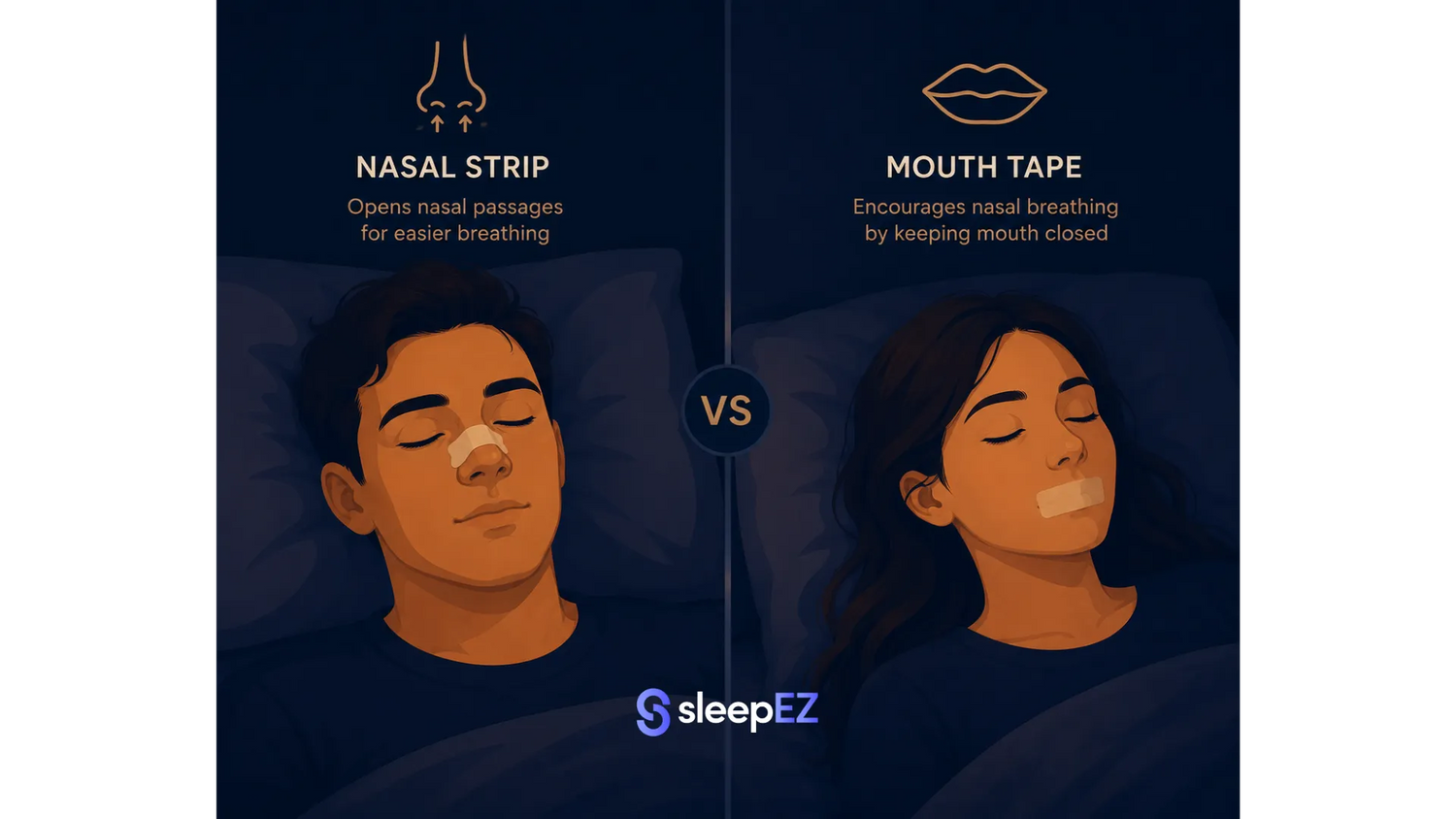
Two solutions keep popping up: nasal strips and mouth tape. One opens your nose. The other closes your mouth. Both claim to help you breathe better at night.
Here's the thing. They solve different problems. Pick the wrong one, and you're still waking up exhausted. So which one actually works for your situation?
Quick Answer: Nasal Strips vs Mouth Tape
Nasal strips and mouth tape solve different problems:
- Nasal strips open blocked nasal passages to make nasal breathing easier
- Mouth tape keeps the mouth closed during sleep to encourage nasal breathing
The key difference: Nasal strips address why you might mouth breathe (congestion). Mouth tape addresses the act of mouth breathing itself.
If you have nasal congestion that forces mouth breathing, nasal strips may help more. If your mouth simply falls open during sleep despite clear nasal passages, mouth tape is the more direct solution.
If you have both problems, using them together may provide the best results.
Quick Comparison
| Feature | Nasal Strips | Mouth Tape |
|---|---|---|
| What It Does | Opens nasal passages | Keeps mouth closed |
| Best For | Nasal congestion | Mouth breathing |
| Pros | Drug-free, instant relief, easy to use | Stops mouth breathing, deeper sleep, prevents dry mouth |
| Cons | Doesn't stop mouth breathing, can irritate skin | Takes 1-2 nights to adjust |
| Works Immediately? | Yes | Yes, but feels different at first |
Why Does Nasal Breathing Matter for Sleep?
Your nose is specifically designed for breathing in ways your mouth is not:
- Filters air, nasal hairs and mucous membranes trap particles, bacteria, and allergens
- Humidifies air, adds moisture to prevent dry throat and airways
- Warms air, brings air to body temperature before it reaches the lungs
- Produces nitric oxide, a molecule that helps dilate blood vessels and may improve oxygen uptake
- Reduces snoring, mouth breathing is a primary driver of snoring
When you breathe through your mouth during sleep, you bypass all of these functions. The result is often dry mouth, sore throat, more disruptive snoring, and potentially lower sleep quality.
What Are Nasal Strips? (How They Work)
Nasal strips are external nasal dilators. You stick them across the bridge of your nose, and they physically pull your nostrils open from the outside.
The strips contain spring-like bands that lift and widen your nasal passages. This reduces airflow resistance and makes it easier to breathe through your nose.
Best for: Fighting the feeling of nasal congestion or stuffiness. If your nose feels blocked, nasal strips can help open things up.
What Causes Mouth Breathing at Night?
Understanding the cause helps you choose the right solution:
- Nasal congestion, allergies, colds, sinus inflammation, or structural issues block the nasal passages
- Habit, some people have simply developed a pattern of mouth breathing, even with clear nasal passages
- Sleep position, sleeping on your back can cause the jaw to drop and the mouth to open
- Deviated septum, a structural issue that restricts airflow through one or both nostrils
- Enlarged tonsils or adenoids, more common in children, can restrict nasal airflow
- Nasal polyps, soft growths in the nasal passages that reduce airflow
If congestion is the primary cause, nasal strips address the root problem. If it's habit or sleep position, mouth tape may be more effective.
What Is Mouth Tape? (How It Works)
Mouth tape is designed to encourage nasal breathing during sleep. You place a strip of gentle tape over your lips before bed.
The tape creates a light seal that prevents you from defaulting to mouth breathing. It doesn't force your mouth shut. It just reminds your body to use your nose instead.
Best for: Solving habitual mouth breathing, mouth snoring, and waking up with a dry mouth or sore throat. Many people use mouth tape for sleep to maintain nasal breathing throughout the night.
What Causes Nasal Congestion at Night?
Nasal congestion often worsens at night because:
- Lying flat increases blood flow to nasal tissues, causing swelling
- Allergens, dust mites in bedding are a common nighttime trigger
- Dry air, particularly in winter or air-conditioned rooms
- Colds and respiratory infections
- Sinus inflammation, can be chronic or seasonal
If nighttime congestion is your main issue, nasal strips can help open the nasal passages mechanically. For chronic congestion, addressing the underlying cause (allergens, air quality, structural issues) is important.
Nasal Strips vs Mouth Tape: Key Differences
| Feature | Nasal Strips | Mouth Tape |
|---|---|---|
| Opens nasal passages | ✅ Yes | ❌ No |
| Encourages nasal breathing | ❌ No | ✅ Yes |
| Helps dry mouth | ❌ No | ✅ Yes |
| Helps nasal congestion | ✅ Yes | ❌ No |
| Helps mouth-breathing snoring | ⚠️ Indirectly | ✅ Yes |
| Helps congestion-related snoring | ✅ Yes | ❌ No |
| Works immediately | ✅ Yes | ✅ Yes |
| Can be used together | ✅ Yes | ✅ Yes |
| Requires clear nasal passages | ❌ No | ✅ Yes |
Here's the most important thing to understand.
Think of it like this: nasal strips open the highway (your nose). Mouth tape closes the wrong exit ramp (your mouth).
A nasal strip makes it easier to breathe through your nose, but it cannot stop you from breathing through your mouth. If you're a mouth breather, a nasal strip won't fix that problem.
Your mouth will still fall open during sleep.
Mouth tape ensures you actually use your nose. Even if your nasal passages are wide open, your body might still choose to breathe through your mouth out of habit.
That's where mouth tape comes in.
Nasal Strips vs Mouth Tape for Snoring
Snoring has multiple causes, and the right solution depends on which type you have.
Mouth-breathing snoring: When your mouth falls open during sleep, air flows over relaxed throat tissues, causing vibration and snoring. Mouth tape addresses this directly by keeping the mouth closed and redirecting airflow through the nose.
Congestion-related snoring: When your nose is blocked, you're forced to breathe through your mouth, which then causes snoring. Nasal strips open the nasal passages, making nasal breathing easier and reducing the need to mouth breathe.
Mixed snoring: Many people have both issues. Using nasal strips and mouth tape together may provide the most comprehensive approach.
| Snoring Type | Better Solution |
|---|---|
| Mouth falls open during sleep | Mouth tape |
| Nose feels blocked at night | Nasal strips |
| Both issues present | Use both together |
| Loud snoring with fatigue | Consult a doctor (may be sleep apnea) |
Can You Use Mouth Tape and Nasal Strips Together?
Yes. They actually form a powerful combination.
Using a nasal strip to open your passages while using mouth tape to ensure you breathe through them is the ultimate solution for anyone who feels congested and is also a mouth breather.
The nasal strip reduces resistance. The mouth tape keeps you breathing the right way. Together, they address both problems at once.
The Verdict: Which Solution Do You Need?
Your choice depends on what problem you're trying to solve.
Choose nasal strips if: Your only issue is nasal congestion. You don't breathe through your mouth at night, but your nose feels blocked.
Choose mouth tape if: Your main issue is mouth breathing, waking up with a dry mouth, or mouth snoring. Your nose works fine, but your mouth keeps falling open.
Choose both if: You suffer from both nasal congestion AND mouth breathing. This combination gives you the full solution.
If mouth breathing is your issue, the right tape makes all the difference. Look for one that's shaped to fit your lips comfortably and uses skin-friendly materials.
A good mouth tape should stay secure through the night without irritation. Breathe Mouth Tape is designed with a lip-shaped fit that stays put while you sleep, making it easier to maintain nasal breathing all night.
Nasal Strips vs Mouth Tape for Dry Mouth
If you wake up with a dry mouth, the cause is almost always mouth breathing overnight.
Mouth tape is the more direct solution for dry mouth. By keeping your lips gently closed, it prevents air from flowing over your tongue and evaporating saliva.
Nasal strips can help if nasal congestion is forcing you to breathe through your mouth. By improving nasal airflow, they make it easier to keep your mouth closed, but they don't prevent your mouth from falling open if it's a habit rather than a congestion issue.
The most effective approach for dry mouth: Try mouth tape first. If you find it difficult to breathe comfortably through your nose with your mouth taped, add nasal strips to improve nasal airflow before applying the tape.
Can Nasal Strips Replace Mouth Tape?
No. Nasal strips can make nasal breathing easier, but they cannot prevent your mouth from falling open during sleep.
If your mouth naturally opens during sleep, regardless of how clear your nasal passages are, nasal strips alone won't solve the problem. Mouth tape is the only tool that directly addresses the act of mouth breathing by keeping the lips closed.
Can Mouth Tape Replace Nasal Strips?
Not if nasal congestion is your primary issue.
If your nose is blocked and you apply mouth tape, you may find it uncomfortable or difficult to breathe. Mouth tape should only be used when you can breathe comfortably through your nose.
If you have both congestion and mouth breathing, use nasal strips to open the nasal passages first, then add mouth tape to keep the mouth closed.
Can You Use Both Together?
Yes, and for many people, using both together is the most effective approach.
The combination works like this:
- Nasal strips open your nasal passages, making nasal breathing easier
- Mouth tape keeps your mouth closed, ensuring you actually breathe through your nose
This combination is particularly useful for people with mild nasal congestion who also tend to mouth breathe during sleep.
How to use them together:
- Apply nasal strips first, press firmly along the bridge of your nose
- Breathe through your nose for 1–2 minutes to confirm airflow is comfortable
- Apply mouth tape over your lips
- If you feel any difficulty breathing, remove the mouth tape immediately
Which Solution Is Right for You?
Use this guide to identify the best starting point:
Do you wake up with a dry mouth most mornings? → Start with mouth tape. Dry mouth is almost always caused by mouth breathing overnight.
Does your nose feel blocked or congested at night? → Start with nasal strips. Address the congestion before trying mouth tape.
Do you snore, and your mouth falls open during sleep? → Try mouth tape. Keeping the mouth closed may reduce or eliminate this type of snoring.
Do you snore, and your nose feels blocked? → Try nasal strips first. Improving nasal airflow may reduce congestion-related snoring.
Do you have both congestion and mouth breathing? → Use both together. Nasal strips to open the passages, mouth tape to keep the mouth closed.
Not sure which applies to you? → Check our article on signs of mouth breathing to identify whether mouth breathing is your primary issue.
Who Should Avoid Mouth Tape?
Mouth tape is not suitable for everyone:
- People with significant nasal congestion, if you can't breathe comfortably through your nose, do not use mouth tape
- People with a deviated septum or nasal polyps, structural issues may prevent adequate nasal airflow
- People with diagnosed or suspected sleep apnea, consult your doctor before using mouth tape; it is not a treatment for sleep apnea
- People with respiratory conditions, asthma, COPD, or other conditions affecting breathing
- Children, only under the guidance of a healthcare professional
If in doubt, consult your doctor before starting mouth tape.
Who Should Avoid Nasal Strips?
Nasal strips are generally safe for most adults, but avoid them if you have:
- Skin irritation or sensitivity around the nose, the adhesive may cause redness or irritation
- Known adhesive allergies, check the product ingredients
- Broken or damaged skin on the nose bridge
- Active skin conditions (eczema, psoriasis) on the nose
Nasal strips are not a treatment for sleep apnea and should not be used as a substitute for medical assessment if you have symptoms of sleep apnea.
Frequently Asked Questions
Are nasal strips or mouth tape better for snoring?
It depends on the type of snoring. Mouth tape is better for snoring caused by mouth breathing.
Nasal strips are better for snoring caused by nasal congestion. Using both together addresses both causes.
Can you use mouth tape and nasal strips together?
Yes. Apply nasal strips first to open the nasal passages, confirm comfortable nasal breathing, then apply mouth tape.
This combination is effective for people with both congestion and mouth breathing.
Do nasal strips stop mouth breathing?
No. Nasal strips make nasal breathing easier by opening the nasal passages, but they cannot prevent your mouth from falling open during sleep.
Mouth tape is needed to address the act of mouth breathing itself.
Does mouth tape help a blocked nose?
No. Mouth tape keeps the mouth closed but doesn't address nasal congestion.
If your nose is blocked, use nasal strips first to ensure you can breathe comfortably through your nose before applying mouth tape.
Which is better for dry mouth?
Mouth tape is more directly effective for dry mouth caused by mouth breathing. Nasal strips can help if congestion is forcing you to breathe through your mouth, but they don't prevent the mouth from opening.
Which is better for sleep apnea?
Neither nasal strips nor mouth tape is a treatment for sleep apnea. If you have symptoms of sleep apnea, loud snoring, gasping during sleep, extreme daytime fatigue, consult your doctor for proper assessment.
Can mouth tape help if I have allergies?
If allergies are causing nasal congestion that forces mouth breathing, treating the congestion (with antihistamines, nasal rinses, or nasal strips) should come first. Once nasal airflow is comfortable, mouth tape may then be helpful.
Can I use nasal strips every night?
Yes. Nasal strips are safe for nightly use.
Replace them each night as the adhesive weakens after a single use.
Is mouth tape safe to use every night?
Yes, for healthy adults who can breathe comfortably through their nose. Many people use mouth tape as part of their nightly routine without issues.
Take Control of Your Sleep
The choice between nasal strips and mouth tape isn't about which product is better. It's about understanding what's actually causing your sleep problems.
Nasal congestion needs one solution. Mouth breathing needs another. And if you have both issues, you need both tools.
Now you know the difference. Choose the solution that fits your problem, and finally get the restful sleep you deserve.


Leave a comment
This site is protected by hCaptcha and the hCaptcha Privacy Policy and Terms of Service apply.