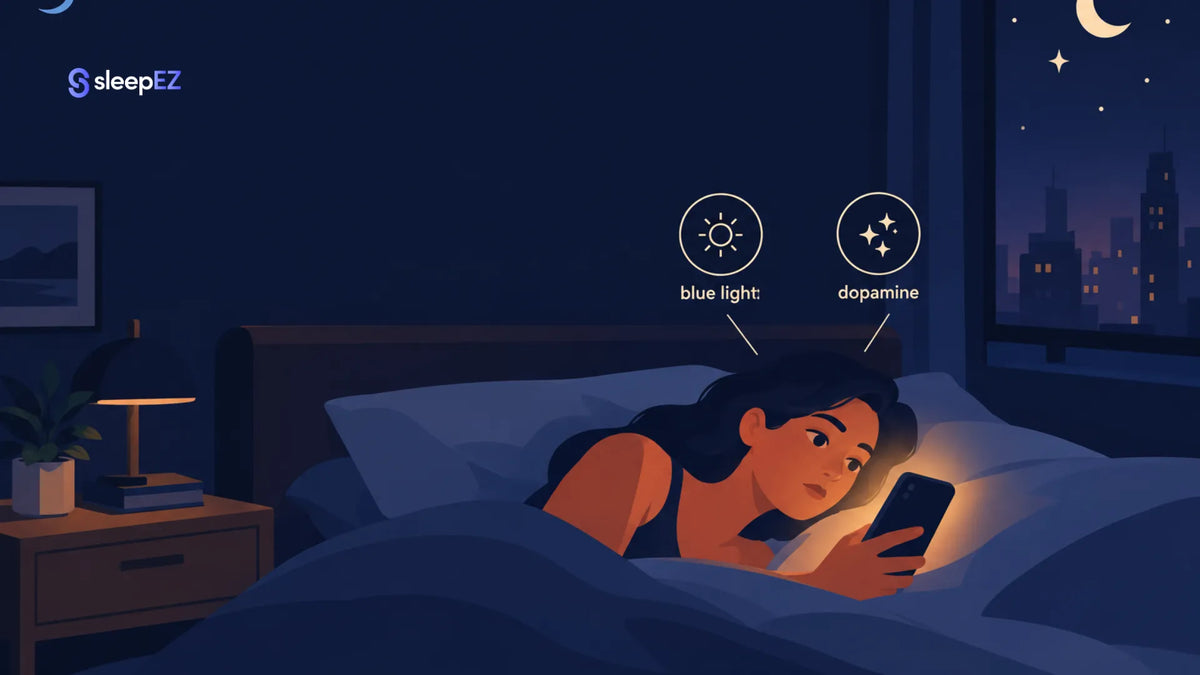
Your phone is the modern alarm clock, newspaper, and TV rolled into one. But bringing it into bed is like drinking an espresso at midnight. Your brain can't tell the difference between your screen and the sun.
This isn't about willpower. Your devices are designed to keep you awake. The apps, the notifications, the endless scroll are all engineered to hijack your sleep cycle. Here's what's actually happening in your brain, and how to fix it without going full digital hermit. Dr Andy Galpin, human performance scientist speaking on The Diary Of A CEO, argues most people are solving the wrong problem when they blame blue light alone. It's not the light. It's what's happening in your head once the screen is on.
1. The Biological Hit (Blue Light)
Blue light mimics the sun. Your phone emits wavelengths between 460 and 480 nanometers, which is the exact spectrum that tells your brain "it's morning."
Deep inside your brain sits the suprachiasmatic nucleus (SCN). Think of it as your internal clock. When blue light hits your eyes, the SCN stops producing melatonin, the hormone that makes you sleepy.
Research from Harvard Medical School found that blue light doesn't just block melatonin. It shifts your entire sleep schedule by up to three hours. Your body thinks 11 PM is 8 PM.
Federal studies confirm that blue wavelengths between 446 and 477 nanometers cause dose-dependent melatonin suppression. The longer you scroll, the worse it gets.
2. The Psychological Hit (Dopamine)
Blue light is only half the problem. The other half is what you're looking at.
Social media, news feeds, and video apps are built on something called "intermittent reinforcement." Every swipe might show you something interesting. Your brain releases dopamine each time, keeping you in a seeking state.
This is called "Revenge Bedtime Procrastination." You feel like you didn't get enough "me time" during the day. So you steal it back at night by scrolling. Your brain stays alert, hunting for the next dopamine hit.
Sleep requires your brain to shift from seeking mode to rest mode. Scrolling makes that shift impossible. You're telling your brain to stay awake and alert when it should be winding down.
Dr Andy Galpin makes the same point from a slightly different angle: "It's not the fact that necessarily screen usage is shooting your face with a bunch of blue light.
What's more dangerous about your screen is the arousal associated with the search for novelty." Whatever you call it, dopamine-seeking or novelty-arousal, the mechanism is the same.
Your brain stays in seeking mode instead of shifting into rest mode, and no amount of blue-light filtering fixes that on its own.
Even "Safe" Alternatives Aren't Automatically Safe
Here's the nuance most blue-light advice skips: swapping your phone for a book doesn't automatically fix anything. Dr Andy Galpin points to research comparing TV, tablet, phone and reading before bed, noting they can all be equally dangerous to sleep, not because of the light involved, but because of how engaging the content is.
"In the studies that have looked at things like TV time versus tablet versus phone versus reading, those all can be equally dangerous to sleep," he says. A gripping thriller at 11pm can keep your brain in seeking mode just as effectively as an infinite scroll.
Galpin's own household is a useful example. He falls asleep fine watching a big, blue-light-heavy TV screen because what he's watching, a low-engagement documentary, doesn't grab him.
His partner struggles more from reading, because the books she picks are chosen specifically for how gripping they are.
The test that matters isn't "is this a screen." It's whether what you're consuming feels like checking out for the night or like you're hunting for what happens next. If it's the second one, that's the part worth changing, whatever device or format it's on.
Is It Bad to Sleep with Your Phone Near Your Head?
Yes, but not for the reasons you think.
The radiation debate is overblown. The real problem is psychological. Your phone near your pillow keeps you in a state of micro-vigilance. Part of your brain stays alert, waiting for a notification.
Studies show that even sleeping with your phone nearby raises baseline cortisol levels. You're essentially "on call" all night, which fragments your sleep quality.
The solution is simple but hard: move your phone to another room.
The hardest part isn't the phone. It's the sudden silence. Most people use their phones as white noise machines without realising it.
Replace the void with actual white noise. The Hush+ Sound Machine creates a comforting audio environment so you don't feel alone without your device. It masks outside sounds and gives your brain something to focus on besides the urge to check notifications.
How to Quit Screens (The "Replacement" Strategy)
Don't just stop scrolling. Replace it with something better.
Your brain craves stimulation before bed. Fighting that urge creates friction. You need a bridge between "fully awake" and "ready to sleep."
The "Audio-Only" Transition
Switch from visual content to audio content. Podcasts, audiobooks, and sleep stories satisfy your need for stimulation without the melatonin-killing blue light.
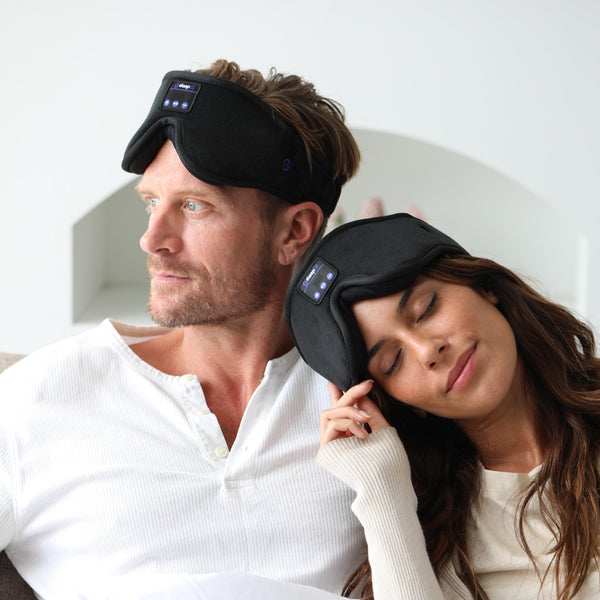
The Dreamy Sounds Sleep Mask has built-in Bluetooth speakers. Put it on, play an audiobook, and your brain gets the entertainment it wants. The blackout design ensures 100% darkness, so your melatonin production stays on track.
Recommended for this guide
Dreamy Sounds Sleep Mask
Built-in Bluetooth speakers under a 100% blackout mask, so you can swap the scroll for a podcast or a sleep story and still get complete darkness for melatonin.
Pick something low-engagement here too, not a gripping thriller. The same test applies as above: does it feel like checking out for the night, or like you're chasing the next twist? A slow, familiar story beats a page-turner at bedtime, audio or not.
You're not depriving yourself. You're giving yourself a better option.
Some people worry they'll stay awake listening. Set a 30-minute sleep timer. Most audiobook apps have this built in. You'll drift off before it ends.
The 3-2-1 Bedtime Rule (The Framework)
This simple rule covers all the bases:
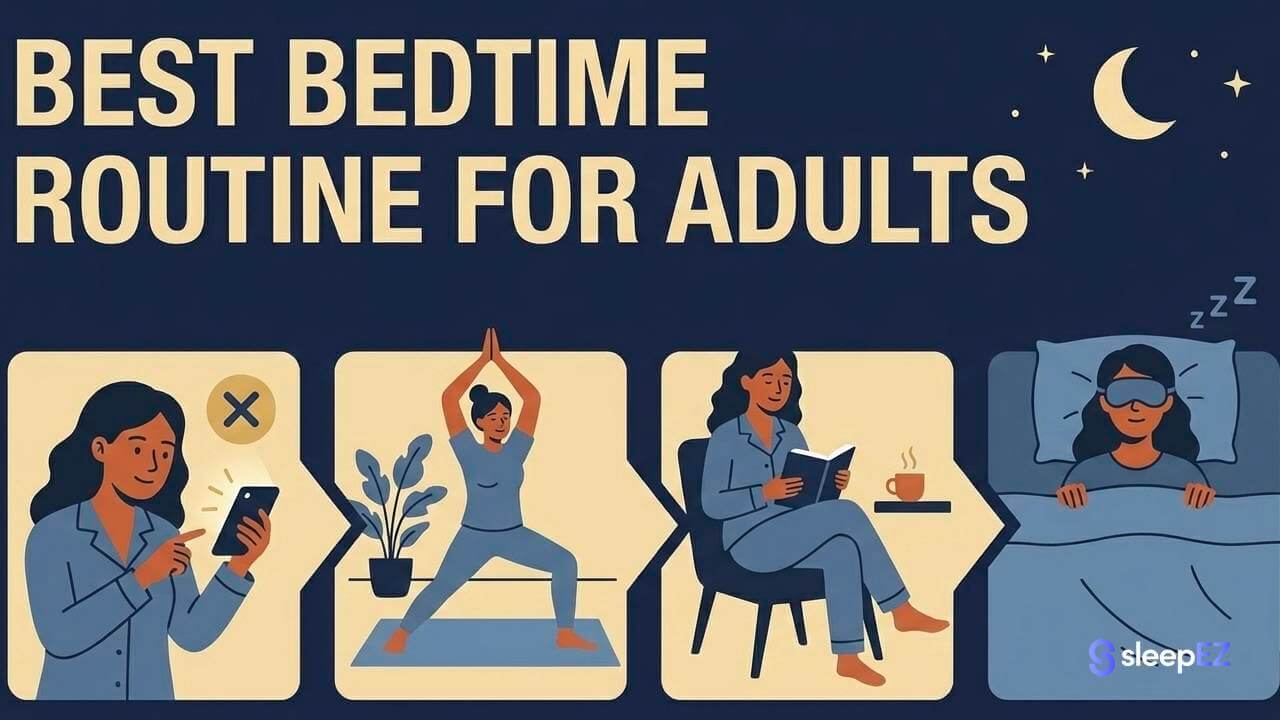
3 hours before bed: No food. Digestion raises your core body temperature, which blocks sleep onset.
2 hours before bed: No work. Mental stress keeps cortisol elevated.
1 hour before bed: No screens.
Following all three is ideal. But if you can only do one thing, focus on the screen rule.
If you absolutely must use screens in that final hour, wear blue light blocking glasses. Columbia University research found that amber-tinted lenses before bed improved sleep quality in people with insomnia. Real blocking glasses work better than your phone's "Night Shift" mode, though remember they only address the light half of the problem, not the arousal half.
Or skip the compromise entirely and use your Dreamy Sounds Sleep Mask for audio content only.
Watch: Dr Andy Galpin on Screens and Sleep
Dr Andy Galpin, human performance scientist, on why arousal, not blue light, is the real issue with screens before bed, from The Diary Of A CEO.
The Bottom Line: 3 Ways Electronics Damage Sleep
| Problem | What Happens | Solution |
|---|---|---|
| Melatonin Suppression | Blue light (460-480nm) tricks your brain into thinking it's daytime | No screens 1 hour before bed, or use blue blocking glasses |
| Dopamine Loops | Infinite scroll (and gripping books or shows) keeps your brain in high-alert seeking mode | Switch to low-engagement content, audio or otherwise |
| Sleep Fragmentation | Phone proximity causes micro-vigilance and stress | Move phone to another room, use white noise machine |
Make the Switch Tonight
Your phone doesn't belong on your pillow. It belongs in the kitchen, charging for tomorrow.
Move it tonight. Turn on your Hush+ Sound Machine. Slip on your Dreamy Sounds Sleep Mask and queue up a low-engagement audiobook, not the one you can't put down.
Your brain has been fighting against you every night. Now you're fighting back.
References
- Harvard Medical School. "Blue light has a dark side." Harvard Health Publishing. https://www.health.harvard.edu/staying-healthy/blue-light-has-a-dark-side
- Brainard GC, et al. "Blue light from light-emitting diodes elicits a dose-dependent suppression of melatonin in humans." Journal of Applied Physiology. 2011. https://pubmed.ncbi.nlm.nih.gov/21164152/
- Shechter A, et al. "Blocking nocturnal blue light for insomnia: A randomized controlled trial." Journal of Psychiatric Research. 2017. https://pmc.ncbi.nlm.nih.gov/articles/PMC5703049/
- Dr Andy Galpin, human performance scientist. Interview on screens, arousal and sleep. The Diary Of A CEO, hosted by Steven Bartlett. https://www.youtube.com/watch?v=dmz--DQty8o

Leave a comment
This site is protected by hCaptcha and the hCaptcha Privacy Policy and Terms of Service apply.