The world record is 11 days. But you start losing your mind after just 24 hours.
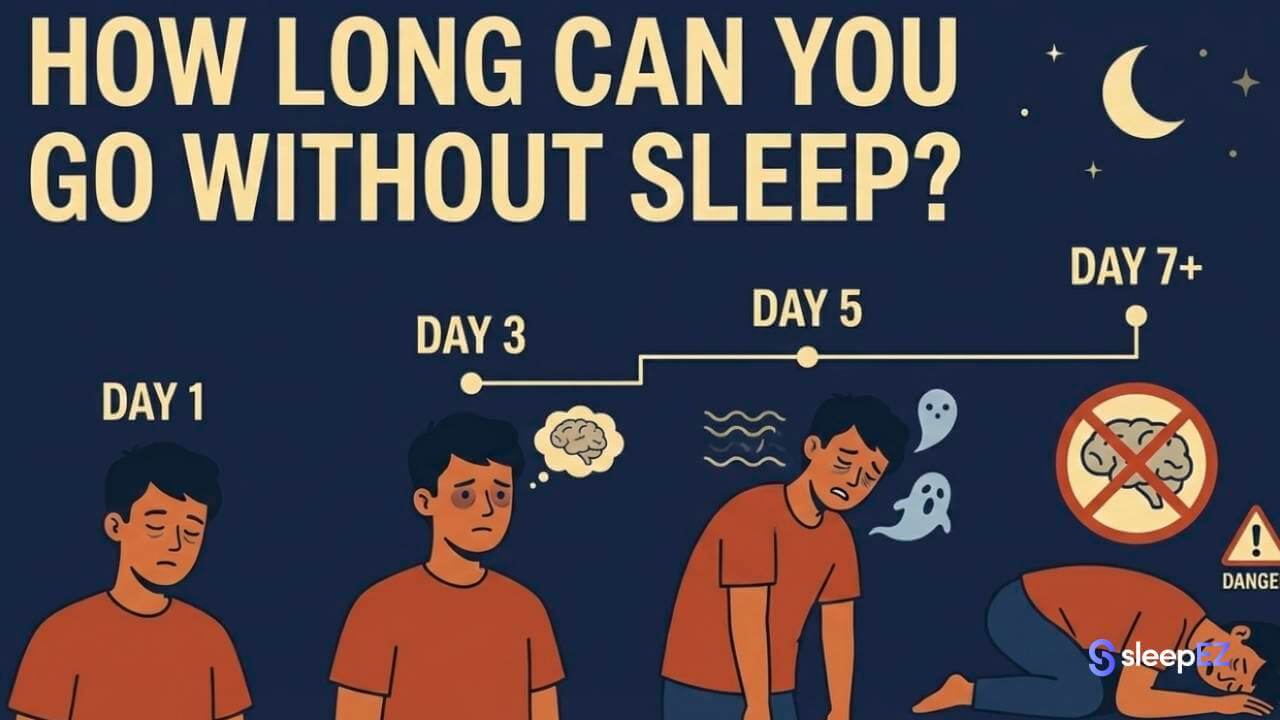
In 1964, 17-year-old Randy Gardner stayed awake for 264 hours straight under medical supervision at UCLA. He wanted to break a world record. By day three, he couldn't focus his eyes. By day four, he thought a street sign was a person. By day eleven, he could barely speak in complete sentences.
But here's the strange part: he didn't die. After the experiment ended, Gardner slept for 14 hours and woke up mostly normal. Within ten days, doctors found no lasting damage.
So can you actually die from not sleeping? Not directly. Your brain won't let you. Before you reach a fatal point, your body forces you into microsleeps, which are brief blackouts where your brain shuts down for seconds at a time. The real danger isn't death from sleep loss itself. It's what happens when you're awake but your brain isn't fully online anymore.
The Sleep Deprivation Timeline (Hour-by-Hour)
Your brain starts breaking down faster than you think. Here's what happens at each stage.
24 Hours: The "Drunk" Phase
You feel tired, sure. But the scary part is how much your brain has already declined.
Research from the University of Pennsylvania's Center for Sleep and Circadian Neurobiology found that staying awake for 24 hours impairs your performance as much as having a blood alcohol level of 0.10%. That's legally drunk in every U.S. state.
Your symptoms at this stage:
- Severe brain fog and slow reaction times
- Trouble forming sentences or finding the right words
- Mood swings and irritability over small things
- Loss of coordination, like stumbling or dropping objects
- Reduced ability to make good decisions
You might think you're fine. You're not. Your self-assessment is already broken at this point.
36 Hours: The Hormone Crash
Your body's chemical balance starts falling apart.
Cortisol, your stress hormone, spikes to abnormal levels. At the same time, hormones like testosterone and growth hormone drop. This creates a cascade of problems:
- Your heart rate increases even when you're sitting still
- Your appetite goes haywire, craving sugar and carbs
- Your immune system weakens
- Inflammation increases throughout your body
You're not just tired anymore. Your body is in crisis mode, trying to force you to sleep.
48 Hours: The "Microsleep" Phase
This is where things get dangerous.
Microsleeps are brief episodes, usually lasting 1 to 30 seconds, where your brain simply turns off. You're technically awake with your eyes open, but you're not processing anything. You won't remember these gaps. To you, time just skips forward.
Studies published by the National Institutes of Health show that drowsy drivers experience severe drops in vehicle control during microsleep episodes. These blackouts cause about 1,500 deaths every year in the U.S. alone.
If you absolutely must stay awake for safety reasons, silence becomes your enemy. Your brain craves sleep so badly that quiet environments trigger microsleeps faster. Use a white noise machine set to a high-frequency sound or play upbeat music. The stimulation can help keep your brain active until you reach safety.
But understand this: you're fighting biology. Every minute past 48 hours makes microsleeps more frequent and longer.
72 Hours: The Hallucination Phase
After three days, your brain starts doing something truly bizarre. It begins dreaming while you're still awake.
This happens because of REM intrusion. Your brain is so desperate for REM sleep that it forces dream imagery into your waking consciousness. You'll see things that aren't there:
- Shadows moving in your peripheral vision
- Objects morphing or breathing
- Faces in patterns on walls or floors
- Sounds that nobody else hears
Paranoia sets in too. You might become convinced that people are plotting against you or that you're being watched. Your sense of time becomes unreliable. Minutes feel like hours.
Randy Gardner experienced all of this. He mistook a street sign for a person. He thought he was a famous football player. He became hostile and suspicious of the researchers monitoring him.
96+ Hours: Psychosis and Dissociation
Beyond four days, you enter territory that few people have experienced.
Your sense of identity starts to fragment. You might not recognize yourself in a mirror. Speech becomes nearly impossible because you can't hold thoughts long enough to form sentences. Your body feels disconnected from your mind.
At this stage, you're not really "awake" in any meaningful sense. You're caught between consciousness and unconsciousness, unable to function in either state properly.
Can You Die From Lack of Sleep?
Not directly, but the answer is more complicated than a simple yes or no.
Your brain has a failsafe. Before you die from sleep deprivation itself, your body forces you into microsleeps. These brief shutdowns are your brain's emergency protocol. It will get sleep one way or another, even if it's just a few seconds at a time.
There is one exception: Fatal Familial Insomnia, or FFI. This is an extremely rare genetic disease where people progressively lose the ability to sleep. Over months, their condition worsens until they die. But FFI doesn't kill through simple sleep loss. It causes severe damage to the thalamus, a brain region critical for consciousness and body regulation.
For normal people, the real danger comes from accidents. When you're in the "drunk" state after 24 hours or experiencing microsleeps after 48 hours, you become a threat to yourself and others. Driving, operating machinery, or even walking down stairs becomes potentially fatal.
About 40,000 injuries happen every year in the U.S. because of drowsy driving. These aren't people who fell asleep at the wheel. Many of them were in microsleeps for just a few seconds. That's all it takes.
How to Recover: The "Crash Protocol"
Once you finally stop fighting sleep, your body needs help to recover properly. You can't just pass out anywhere and expect full recovery.
Your goal is to maximize deep sleep, which is Stage 3 of the sleep cycle. This is where your brain repairs damage and consolidates memories. After severe sleep deprivation, your brain will spend extra time in deep sleep to pay back your "sleep debt."
But you need the right conditions.
Total Darkness for Melatonin Production
Even tiny amounts of light can pull you out of deep sleep. Your brain detects light through your eyelids, which signals your body to reduce melatonin production.
After days without sleep, you need to stay in deep sleep as long as possible. Use a contoured bluetooth sleep mask to guarantee complete darkness. The bluetooth feature lets you play binaural beats or white noise, which can help induce deeper rest without disrupting your sleep with cables or earbuds.
A regular eye mask often lets light leak through the sides. A contoured design creates a seal around your eyes while giving your eyelids room to move during REM sleep.
Audio Isolation for Sleep Continuity
Your brain is fragile after deprivation. Normal sounds that you'd usually sleep through will wake you up.
A door closing, traffic noise, or even a refrigerator humming can jolt you awake. When this happens after severe sleep loss, you lose precious recovery time. Use high-fidelity sleep earplugs to create sensory isolation.
These aren't the foam plugs you get at a pharmacy. High-fidelity earplugs reduce sound volume while maintaining clarity. This means you can still hear an alarm or someone calling your name, but background noise gets filtered out.
Plan for 9 to 10 hours of recovery sleep after severe deprivation. Your body might need even more. Don't set an alarm unless absolutely necessary. Let your brain take what it needs.
Timeline of Sleep Deprivation: Quick Reference
| Time Awake | Physical State | Mental Impairment | Danger Level |
|---|---|---|---|
| 24 Hours | Coordination equals legal intoxication (0.10% BAC) | Brain fog, poor decisions | High for driving/machinery |
| 36 Hours | Extreme fatigue, hormonal imbalance | Slowed thinking, mood instability | Very High |
| 48 Hours | Microsleeps begin (brain shuts down for seconds) | Memory lapses, confusion | Extreme |
| 72 Hours | Hallucinations and paranoia set in | Loss of reality, visual distortions | Severe |
| 96+ Hours | Psychosis and dissociation | Identity confusion, near-total dysfunction | Critical |
Source: Research compiled from University of Pennsylvania Medical School and NIH studies
The Bottom Line
You might not die from staying awake, but your brain will force you to shut down eventually. The microsleeps will come whether you want them or not.
Don't test your limits. The damage you do to your cognitive function, your emotional stability, and your physical health isn't worth satisfying curiosity. If you're in sleep debt right now, even just a few days of poor sleep, pay it back tonight.
Set up your recovery sleep properly. Use sleep earplugs and a blackout mask. Turn off your phone. Give your brain the darkness and silence it needs to repair itself.
Your brain kept you alive through years of experience and learning. Return the favor. Let it rest.

Leave a comment
This site is protected by hCaptcha and the hCaptcha Privacy Policy and Terms of Service apply.